diumenge, 23 d’abril del 2017

NEWS

BYE-BYE PLASTIC BOTTLES, OOHO! IS THE FUTURE

Nowadays we are wasting so much plastic, and we know plastic is not biodegradable. That’s why Ooho! has been created. Ooho! is an edible water bottle created using gelification (a technique initially used in cooking created by Ferran Adriá) which objective is to replace plastic bottles. It looks like a balloon or even like a breast implant, and will go on the market within a year. Ooho! was first invented by three engineers in 2014, but now they are fundraising to achieve their objective to substitute the plastic bottles for this more ecologic option.


Maybe you are wondering: how are they made? Well, the sphere has a double gelatinous membrane made of sodium alginate (which is taken from brown algae) and calcium chloride. As it was said before, the spheres are created using gelification to make liquids turn into gel. Therefore, it is so natural that you can actually eat it, and it’s entirely biodegradable. Not only it’s biodegradable, but also the packaging is cheaper than plastic, and can contain water, soft drinks, spirits…Each sphere contains 250 ml of water or another drink and costs 2 cents to make one unit (less than a plastic bottle). Will Ooho! be the future?


PERSONAL OPINION:

When I first saw this news, I found it very interesting. Not only plastic bottles, but also plastic in general contaminate a lot (more than we think), and people are acting like they don’t care. I don’t know about you, but I don’t want to live in a plastic mountain. Projects like this contribute to fight against global warming, and to the defense of the environment, so that’s why I like it so much. Even though at first maybe it will be a little bit strange, I want to try Ooho! as soon as possible, and I hope within some years it will substitute plastic bottles.

YOUR SAY

BRITISH MUSEUM TASK

While we were in London, we visited the British Museum. There, we had to do one task that consisted in finding some artworks in the museum. So we divided us in groups of 4-5 and we started searching. My group and I found them all:

ROSETTA STONE: The first work that we had to find was the famous Rosetta Stone, which is a granodiorite stele found in 1799. Its importance is huge because it is written in Ancient Egyptian using the hieroglyphic script, using the Demotic script and also in Ancient Greek. The three versions say almost the same, so the discovery of Rosetta Stone helped deciphering the Egyptian hieroglyphs (as the Greek was a known language). For me, Rosetta Stone is one of the “must-see” of the British Museum. Although, it was a shame that there were a lot of people all the time contemplating it, so we couldn’t appreciate it properly.


EGYPTIAN MUMMIES: The British Museum has 120 Egyptian human mummies and over 300 animal mummies (most of them are cats). A curious fact is that the museum has a four metre long mummified crocodile! But we weren’t able to find it. At the end, we only took a photo of a normal mummy. For me, mummies have always caught my attention, because I find them very curious. So it was nice to see some of them.


ASSYRIAN LION HUNT RELIEFS: Before I went to the museum, I didn’t know about these reliefs, but now I have investigated and I found out that they are regarded as "the supreme masterpieces of Assyrian art", and that they were found in the North Palace of Nineveh. The reliefs show a ritual hunt done by King Ashurbanipal in an arena, where he had to kill Asian lions with arrows, spears or his sword. It wasn’t the artwork that I liked the most in the museum, but it was good and interesting to see it.


PARTHENON SCULPTURES: The Parthenon is an ancient temple located on the Athenian Acropolis in Greece), and it’s dedicated to the goddess Athena. It was constructed between the 447 BC and the 438 BC and it’s considered the most important surviving building of Classical Greece and one of the world’s greatest cultural monuments. Although the temple is situated in Greece, the Parthenon sculptures of the facade are in the British Museum. This artwork was one of the most interesting ones for me, because in the subject History of Art we have studied it, so it was nice to see the original ones. Also, the Ancient Greek period has always caught my attention. 


CYRUS CYLINDER: It is an ancient clay cylinder (now broken into several pieces) on which is explained the conquest of Babylon by Cyrus the Great in 539 BC and his own work at Babylon. The cylindrical form is typical of royal inscriptions of the Late Babylonian period. As the Assyrian Lion Hunt reliefs, I didn’t know about this artwork before, but it was interesting and now I know more things about it.


SOMETHING THAT IT IS NOT ANCIENT: One thing that we found that it wasn’t ancient (and that also was really curious) is an exposition called “Cradle to Grave”, which showed how many pills takes an average person during its lifetime. In total, there were about 14,000! When you think about it, there’s so many pills, so it was really interesting to see it.


THE MOST CURIOUS OR SURPRISING OBJECT: Finally, we had to take a photo of the most curious or surprising object. In my case, I took a photo of a tree made of iron. I like it a lot because I think it’s original to represent nature using iron; it’s like a paradox. I don’t know exactly why, but I loved it.


dissabte, 22 d’abril del 2017

BOOK REVIEW

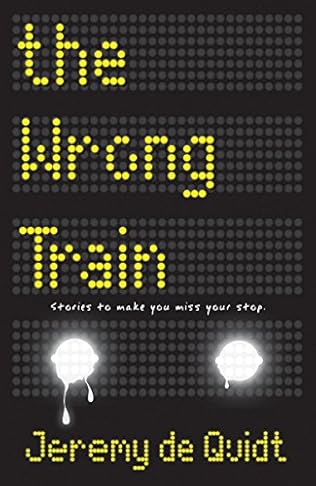
THE WRONG TRAIN, by Jeremy De Quidt

The wrong train is a book written by Jeremy De Quidt. As the title says, it is about a boy who gets on the wrong train in his way home. At first he doesn’t notice it, but when he sees it he decides to get off the train at the next station. So he does, but then he figures out that that’s not a normal station. It’s late night, foggy and it’s cold, so it’s not the best of the situations. Then, an old man with his dog comes around and explains to the boy that no train is going to pass unless he plays his game, but he doesn’t totally explain what that game is about. After that, the old man starts telling the boy short horror stories, to freak him out. Once he finishes with the stories, the man asks the boy which one he liked the most. At first, he didn’t know which one to choose, because he definitely didn’t like any of them at all. But then, as the thinks that choosing a story can bring him back home, he just choose one of them randomly. But his decision will have an impact on his life…

Resultat d'imatges de jeremy de quidt the wrong trainI decided not to reveal the end because maybe some of you would like to read it, so I didn’t want to make a spoiler. About my personal opinion, now that I have finished it, I can tell that I like it. But I like it especially for the ending, which surprised me in a good way. While I was reading, I couldn’t find a connection between the short stories, and in some parts it was a little boring. Focusing on talking about the short stories, there were some of them that I especially liked, like the one called “Babysitting” and the one about the red car (I can’t remember the exact name, sorry). The other ones were good, but I find them so predictable. That’s also one of the reasons why I liked “Babysitting” and the one of the red car, because the ending was unexpended. 

In general, I liked the book, but it definitely isn’t one of my favourites. It’s good to while away the time, and some of the short stories really caught my attention but, for me, the ending it’s the most worthwhile part. Therefore, I recommend this book to pass the time and if you like short scary stories.

DESCRIPTION OF A PAINTING


dissabte, 15 d’abril del 2017

NEWS

FIRST HUMAN HEAD TRANSPLANT

This year, in 2017, will be done the first human head transplant by the neuroscientist Dr. Sergio Canavero and the surgeon Dr. Xiaoping Ren. In August 2016 they found a volunteer to subject himself to this dangerous operation: Valery Spiridonov. Spiridonov is a Russian man who suffers an illness called Werdnig-Hoffman Disease, which is a genetic disorder that affects to the muscles. Due to this illness, Spiridonov has to use a wheelchair and he almost can’t move.
valery-spiridonov-resized.jpg

How will this transplant be done? The first step is to find a suitable donor for Spiridonov. The donor has to be a dead young man, to use his body, and the family has to agree with it. Once the donor has been found, the operation starts: a surgical team will cool Spiridonov’s body to 50 degrees Fahrenheit to delay tissue death in the brain for an hour. Then, simultaneously, two groups of surgeons will decapitate both heads and will exchange them. Once the swap is done, Spiridonov will be in coma for three or four weeks to ensure everything works perfectly.

Even though this transplant may sound futuristic and likely to fail, Canavero has claimed that has a 90% of possibilities to success. For its part, the patient is happy and enthusiastic about the surgery; but there have been scientists that are against it. These scientists argue that Canavero and Ren are promoting junk science and also creating false expectations. Another scientist, Arthur Caplan, said that is not ethical. To answer to these attacks, Canavero said that with the head transplant it will automatically transplant the whole self with the mind, personality and consciousness of the patient. Despite these words, Anto Cartolovni and Antonio Spagnolo, two Italian bioethicists, said that “our cognition is an embodied cognition” and that “the body is a real part in the formation of human self”. Also, there is another ethical issue: if Spiridonov wanted to reproduce with his new body, his children will have the donor’s genetic information. Therefore, the donor’s family would have rights on the kid?


In spite of the criticism, this operation will take place in China or another country outside Europe or the United States if finally it is approved.


PERSONAL OPINION:

Resultat d'imatges de first human head transplantThis is a controversial issue to talk about. On one hand, I see this transplant in a positive way, because it will help Valery Spiridonov to have a better life. He ensured he is excited about the operation and he hopes to survive and get to live better and happier. So, looking in it that way, this transplant sounds positive. But, on the other hand, there’s this ethical issue that makes me reconsider things; especially the issue about the children. If he decides to have kids, genetically talking they will not be his children. But, well, if the patient is happy and the family of the donor too, I don’t see it so bad.

divendres, 14 d’abril del 2017

YOUR SAY

LONDON


Last week, from the 4th to the 7th of April, some of my classmates of 2nd Batxillerat and I went to a trip to London, so in this post I want to explain a little bit what we did and how was the experience from my point of view.


FIRST DAY (April the 4th):
We left from the high-school at 2:30 am, so you can guess we were all sleepy and tired, but also very excited for the trip. We arrived at the Gatwick Airport at 8:30 in the morning and the first thing we did was go to the hostel to leave the suitcases there. After that, we went to Covent Garden, where there’s a huge and beautiful market. We had lunch there and visited it until at 3:30 we had a guided tour with Angus, our guide. At first I thought it would be a little bit boring, because I was very tired and the fact that it was a 2 hour guide didn’t cheered me up, but it ended up being so interesting and pleasant. Angus was a very funny man, and the way he explained things really caught my attention. He also did little performances with us (I participated in one of them). In the tour we visited Trafalgar Square, Saint James Park (where we made a new friend: a squirrel), Buckingham Palace… After the tour we had free time to take photos with the Big Ben and wander around. Finally, we had dinner at Leicester Arms, a restaurant near Picadilly Circus and came back to the hostel.

SECOND DAY (April the 5th):
In the morning (between 9:30 and and 11:30) we visited the British Museum and I have to say it is astonishing. When you enter in it the first thing you see is a large roof made of glass, which is very impressive. We had to do a little work on the Museum: find some artworks. It wasn’t very difficult, but the Museum is huge and we get a little lost searching them. After the visit in the British Museum, we went to Camdem Town market, and it was one of the places I liked the most of London. I can’t tell exactly why, but I loved it! The people, the vibes, the shops… My friends and I ate a pizza there, but you could choose between different types of food from all around the world. But, as always, we end up eating Italian food (it’s a course, wherever I go, I finish eating pizza or pasta). Then, as we couldn’t find a good price to go to a musical, we decided to take a small trip with boat, which was called “Little Venice”. It was pleasant and relaxing, and I enjoyed so much. Then, at night, we did a tour in London visiting the places where Jack the ripper had killed his victims. We were tired in that moment, but I can tell we all enjoyed it so much.


THIRD DAY (April the 6th):

In the morning we visited another museum, this time the National Gallery. Some of us had to comment a painting (this was my case). I did it with Mar Oliva and we commented the Arnolfini Portrait, by Jan van Eyck. We had some problems though: while we were recording us, a security guard cut us off and told us we were too close to the painting (which, in our defense, I have to say we were not, because we were standing in front of the rope that separate the painting from the people). Finally, we were able to finish our commentary, but we were a little mad. Then, another classmate, Iman Danhaji, had to comment the Arnolfini Portrait too, so we were supposed to help her recording as she helped us before. But, then, the security guard came again and told us to leave the room as there were so many people in there. At that point I get very mad because he let a large group of people enter in the room and made us leave, but we were there before. Still, we had to leave the room and came back later. Now that I think about it in perspective it makes me laugh, but at that moment I was mad at him. However, the rest of the visit in the museum was good, and we were able to see some paintings that have studied at class. After visiting the museum, we had free time and my friends and I decided to go to Oxford Street to go shopping. We had dinner in a quite fancy Italian restaurant (you see, always eating Italian food!) and then we bought some clothes. We met with the teachers and the other classmates in the National History Museum and we visited it. The museum was under construction, and we couldn’t see everything, but it was nice and interesting anyway. Then, we visited the fancy mall Harrods, but of course, we didn’t buy anything. After having dinner, we went to Picadilly Circus to see the lights at night, and then we came back to the hostel to rest.


FOURTH DAY (7th April):
This was our last day and we were all so sad. Well, actually, on one hand we wanted to leave because we were all so tired and we wanted to relax at home, but on the other one we wanted to stay a few more days. During the morning we visited South Bank: the Saint Paul’s Cathedral, the Tower Bridge and the Tower of London, the Monument… Even though I was so tired, I decided to go up the Monument, which had 311 steps (and I even get a certificate that claims it!). We also went to the Borough Market, where we had lunch. It was full of people so I was so stressed. After eating, we visited the Tate Modern and we went up to the highest level (you can imagine we took a lot of photos there). Finally, we had a guided tour in the Globe Theatre (Shakespeare’s theatre), which was very interesting. After that, we came back to the hostel to pick up our suitcases and we went to the Gatwick airport. We arrived in Barcelona at 1 am more or less, but we had to wait there for almost two more hours because the air company had lost one of our classmate’s suitcase. Finally, I arrived home at 5 am in the morning: the trip had finished.


This trip has been one of the best trips I have ever made, especially because I have done it with some of my friends and classmates. It’s sad to think about how next year we will be all in different places studying different things, so I think this trip has united us more. I’m so sad it has finished, but I keep some good memories of it.


divendres, 31 de març del 2017

LOVE ESSAY

Do men and women view love differently?

To answer that, it is necessary first to demonstrate if the differences between men and women affect love. Because it is scientifically demonstrated that men and women are not identical, genetically talking: their brains are slightly different. For example, as Dr. Ruben Gur says, a neuroscientist from the University of Pennsylvania, the reason why men and women can view love in a different way “is a matter of how we’re built, not what we learn”. So the conception of love changes depending on the gender, not on the society or the school or family environment you have grown up on. About this fact, even though is it said by a scientist, we don’t agree with it. First, we don’t have to believe everything a scientist says just because he or she is a scientist, because we all know science has been wrong about some things in the history of humanity. Like, for example, Newton’s theory, that although it is scientific, nowadays we know that it’s not exactly true. Therefore, we don’t agree with the sentence that men and women view love in a different way because they are built differently. Well, it is true that this fact can affect to the conception of love, we cannot deny it, but we don’t have to forget that the environment you have grown on also affects it. And with environment, we mean society. Directly or indirectly, society makes you behave some way or another depending on the gender. For example, society makes girls be beautiful, delicate and passive, the typical princess waiting for her charming prince; contrarily, boys have to be brave, strong, but also polite. Or, also, when couples go out to have dinner, men always have to pay, and give flowers to women from time to time. Men have also to be the first ones to ask a woman out. These kind of things are roles that have been there from a long of time ago (fortunately, now are starting to change), and some of them people don’t really notice that they are conventional, and they directly accept them. But, as we just said, they are conventional, they are roles that society has created, but we are able to change them too; and that’s what some people is trying to do now. So, summarizing, we agree that the constitution of men and women are different, and they can affect the way each gender sees love, but our environment also plays an important role in the way we conceive love.

Resultat d'imatges de in love
In addition, talking about other scientific theories that corroborate that men and women see love in a different way because of their genetic constitution, there’s one study that says that men and women also communicate different during times of high emotion; while men are more likely to shut up when the tension is at its maximum, women tend to keep talking, and get mad when the other person stops talking to them. There are also researches which affirm that men are more insensitive and impatient, and more fragile than girls medically and emotionally. This means that boys are more likely to have birth defects and are more easily stressed during their childhood, among other things. Finally, it’s a documented fact that old men are more likely to die after losing his or her partner than women. Therefore, in summary, men are more reactive to emotion than women, so this fact can influence the way men and women love.

So, with these arguments, it is demonstrated that men and women are slightly different about the way they react to certain situations, which can be related to love. So genetics influence the way man and women love, even though the difference between them is not huge and, obviously, there can be exceptions.  We’re not sure if these characteristics really affect the way men and women view love because, as we said, we believe that society has an important role in making the two genders view love differently.


Should boys always ask a girl out or can a girl ask out too?

Is a girl who asks a boy out too daring? Tradition has always told that boys are the ones who have to ask a girl out. That is the romantic way, the way it appears in romantic books, films and in the well-known princesses films, which have a major influence on little kids, especially girls, but also on boys. Nevertheless, it doesn't mean it is the way it has to be done.

The stories we are told since we are little and the society in which we grow up have an important role in our view of the world and its different aspects. In the case of asking out, it's not only the fact that films show that are always boys who ask girls out, but the fact that they, maybe unintentionally, teach girls they should never ask a boy out. There are several consequences, that are usually related with the “what will the people think?”, that can make a girl being afraid of asking a boy out, as Erin Tatum exposes on the article published in the Everyday Feminism Magazine. For instance, girls are taught that asking a boy out makes them take the boy's role in the relationship, causing, on the one hand, making the girls more masculine and, on the other hand, showing the boy as if they were weak. This happens due to the fact that boys are normally supposed to have the lead role in a relationship, getting to the point that if they don't ask the girl out, they are not a “real man”, Erin Tatum says; which shouldn't be like this at all. Yet, as it has been said before, that is society's influence on us. Another teaching given to us is that a girl asking a boy out shows desperation. For many, the fact that a girl asks a boy out means that she can't wait any longer for him to ask her out, and this shows a girl obsessed and desperate. And from our point of view, this is a sexist way to see it, considering that when a boy is chasing after a girl, even when she has told him she doesn't want anything, as Tatum declares, “rather than a sign of creepiness or desperation, this is meant to be perceived as endearing”, while when it is the other way round, it doesn't play out like this. One of the last points the author of the article exposes, is the “unsexiness” of the girl taking an active role. She claims that a girl having agency is seen as someone not sexy and cold-hearted, something in which we don't agree, since many men have admitted being attracted to women who hold the reins of the situation.

Resultat d'imatges de alexis ren and jay alvarrez
All the same, these consequences shouldn't stop girls from asking boys out or society is never going to change. In fact, one of the reasons for girls to do it is to change the situation and show the world that because one thing has been one way for many years and decades, it doesn't mean we have to live with it and stop fighting to change it. This is exposed on the article posted on the online magazine Elite Daily, written by Alexia LaFata, in which she gives several reasons to encourage girls to ask boys out. These reasons are related both on the good results it can have and on the empowering of the female figure and the woman itself. Some reasons LaFata uses to encourage the girls to do it are, for example, that the boy can be too shy to make the move or that you'll get answers about his feelings towards you instead of keep worrying about it and overanalyzing every situation to get to a conclusion. And also, she points out important aspects, such as making decisions by yourself, which should make you aware of the powerful woman you can be, because, as she says, “taking control of what you want is one of the most powerful things a woman can do”. And, in addition, it will help to make you gain self-confidence and, therefore, be happy with yourself, as well as more independent.

However, this is not an opinion everyone shares, and there is still people who are much attached to tradition and don't feel like a woman should ask a man out. In the article The Nice Girl's Guide to Asking a Guy Out, published in the online magazine Psychology Today, Jen Kim explains a case of Michele Bachman, a Republican candidate who revealed that she didn't let her daughters ask a boy out. She also exposes the case of a dating expert, Evan Marc Kratz, who claimed that girls shouldn't ask boys out if they don't want to be seen as “desperate or masculine”, and that instead, they should use their traits to make the boys ask them out. We totally disagree with both Bachman and Kratz, because we think girls should be able to ask guys out with the same ease boys can do it, and it shouldn't mean any problem. The article exposes opinions of other people, and it finishes with the author's opinion. She says that before asking a guy out, you should consider your personality and if you will be able to handle a rejection. There are girls who feel safer being asked than asking, so if you are one of these girls, just don't ask a boy out. We agree with this point, although we think it is quite obvious that if you don't feel like asking out, you don't have to do it, but that's not really the topic that was being discussed, and that's why we weren't really pleased with the article.

In conclusion, we agree with and we stand up for girls asking boys out. Of course, it will always depend on the personality of the girl, if she is more extroverted or shy, but we think that if a girl wants to ask out a boy and feels sure about it, she should be able to do it and he shouldn't be seen as “masculine or desperate”. It should be seen the same way as if a boy did it, because even though traditionally it isn't common a girl asking a boy out, nowadays things should are different, and it should be the same for everyone.

Made by: Paula Caball and Mar Oliva